A Brief History of Tamil Comedy Films: From Before ‘Crazy’ to A.D.

Muni Cinematic Universe. Yes, that is how the Muni-Kanchana series of horror-comedy movies have come to be referred. The first installment Muniwas dished out in the year 2007. And till this date the makers continue to entertain (and terrorise) us with their flavour of comedy. Kanchana 3 wasthe biggest hit of the summer of 2019. It was the fourth film of the MCU. Amidst this, we also had a neat horror comedy in Darling (2015). But for an industry that has been around for 100+ years, why are there only a few takers for the niche genre?

In the initial years (1930s and 40s) Tamil films mainly said the stories from popular Hindu myth like Baktha Prahalada, Meerabai, Harichandra and so on, and various sub-plots of Ramayana, Mahabharata and Tamil myth and literature. There were occasional film adaptations of stage plays and stories from Tamil weeklies, like Maathruboomi and Sathi Leelavathi. And there were these set of films on popular personalities like Tenali Raman, Patinathar, and the like. Interestingly, there were also sporadic outbursts like Pakka Rowdy, Madras CID, etc. Yes, there was this comedy film Sabapthy (1941). But hands down, the loyal pet of the initial decades was mythology.
Gradually, the themes veered to the Raja-Rani domain (basically, stories on power struggle set in some faraway lands), patriotic fervour, and magical stories that were slotted under Brand Vitalaachariyaar.
1952. The Dravidian tsunami set the screens on fire with Parasakthi. Till date, Sivaji Ganesan's debut performance is the gold standard for dialog delivery in films. But as a whole the decade was filled with the likes of Madurai Veeran, Manohara, Gulebakavali and Nadodi Mannan. Yes coming back to humour, though there were ‘comedy tracks’ in films, full length, successful comedy films were not easy to locate. Sabash Meena (1958) was the one that stood out. Even if decades had passed after the roaring success of Charlie Chaplin world over, the reluctance of Tamil film makers to find comfort with full length comedy continued. But due credits to N.S.Krishnan for adding humour to Tamil films in the initial decades of its life.
Adutha Veettu Penn (1960) starring T. R. Ramachandran in the lead role provided a hilarious opening for the new decade. It was a laugh riot, a situational comedy soaked in those old tricks boys always do to impress damsels. There is this famous funny song ‘Kangalum kavi paduthey..’ that serves as a template even till this date. AVP was a truly successful comedy film. Sivaji Ganesan’s Bale Pandiya, another landmark comedy, followed it. Still comedy as a genre was not tried often. 1964. Kadhalikka Neramillali. This is a cult comedy that actor Nagesh carried so effortlessly on his shoulders. The scene where Chellapa (Nagesh playing an aspiring film director) narrates a story to his father is rib-tickling even now. Rajnikanth used a similar scene in his comeback film Chandramuki (2005), more or less to the same comic effect. Then came the crop of Nagesh-K Balachander comedy-dramas like Server Sundaram (KB as the writer), Bama Vijayam, Ethir Neechal and so on. Outside these films the concept of ‘comedy track’ was still in vogue taking a helping hand from J.P.Chandrababu, Manorama, Cho and other assorted ‘comedians’. Galatta Kalyanam with its amusing premise was a feather in the cap of the 60s. Again, Sivaji Ganesan proved his mettle with humour.

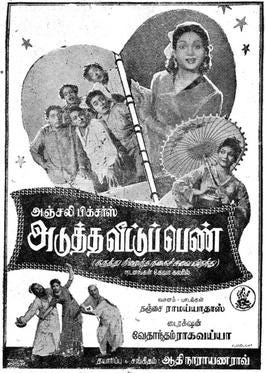

AVP, the old tricks of boys

1970s was a tumultuous, milestone decade for Tamil films — it marked the generational shift from MGR-Sivaji to Rajni-Kamal; from MSV to Ilayaraja; from Raja-Rani and mythology stuff to serious social and family dramas. Also the legendary directors like KB, Bharathiraja and Mahendran delivered their best in this decade. But what about comedy films? Sorry, the species had just slipped from ‘Endangered’ to ‘Critically endangered’.
Thillu Mullu (a Hindi film remake), the evergreen comedy heralded the 1980s. It presented a very new dimension of Rajnikanth. Supported by Thengai Srinivasan, Sowcar Janaki and an ensemble of cast that includes even Nagesh and Kamal Hassan in minor roles, the film became a benchmark for the genre. Due to the continued efforts of film makers and actors like K.Bhagyaraj (Indru Poi Naalai Vaa, Dhavani Kanavugal), R.Pandirajan (Aan Paavam, Oorai Therunjukitten) and Visu (Dowry Kalyanam, Manal Kayiru), the genre continued to be relevant. In fact the comedy films gained traction in Kollywood. But, while many of the these films were great comedies, the maker comedy film of the decade was still Thillu Mullu released in 1981. The eight years that followed only helped the genre escape the deterioration from ‘Critically endangered’ to ‘Near-extinct’.
Yes, there were great ‘comedy tracks’ during the period, performed exceedingly well by the comic legends like Goundami-Senthil. The 80s too witnessed a revolution in Tamil cinema. Mani Ratnam. But comedy was never his forte. And the auteur even dropped the ‘comedy tracks’ from his films very soon, after attempting it for one last time in Agni Natchathiram(1988).
So this was the B.C. of Tamil comedy films. Before ‘Crazy’.
Now let us move to anno Domino (A.D.), in the year of Tamil comedy God ‘Crazy’ Mohan. It was 17th October, 1990, and Michael Mathana Kama Rajan the greatest Tamil comedy of all times got released. The very previous year, with Apoorva Sagodharargal Crazy had established himself as a real talent on humour and dialog writing. ‘Sir.. neenga engeyo poitenga!’ still lingers in the air. Even Crazy’s Kathanayagan (1988) had memorable funny moments (‘Gaja ka dost’). But with MMKR, Crazy took the onscreen comedy to an altogether higher plane, and set a fresh benchmark. And it was too high for anyone to even attempt beating. Yes, doing all the four titular roles Kamal Hassan played an extraordinary part in creating the onscreen magic of humour.
International Decade of Tamil Comedy Films
The Crazy-Kamal combo went on to roll out one comedy after another — Magalir Mattum, Sathi Leelavathi, Avvai Shanmugi and Kadhala Kadhala, all in the same decade. Crazy also collaborated (less successfully) with others, and gave memorable comedy film like Chinna Mapillai. The decade also had non-Crazy hits like Nadigan (1990, a 1962 Hindi film remake), Singara Velan (1992) and Ullathai Allithaa (1996) that were pretty high on humour — but nothing could outwit the Crazy waves that consistently lapped the pristine shores of onscren humour. The new millennium too kick started with the Crazy-Kamal combo. Thenali (2000), Panchathantiram (2002),Pammal K Samandham (2002) and Vasool Raja MBBS (2004, a Hindi film remake). Switch on your telly and randomly play any Tamil comedy channel, and don’t be surprised if you end up watching clips from any of these. The other film makers collected the baton and continued to run up the humour track with all sincerity. Soon we had two more cult classics of comedy — Imsai Arasan 23-aam Pulikesi (2006) and Chennai 600028 (2007). Well, the decade of 2000s was easily the most humour-packed years of Tamil cinema. May be the UNO should have it as the International Decade of Tamil Comedy Films.

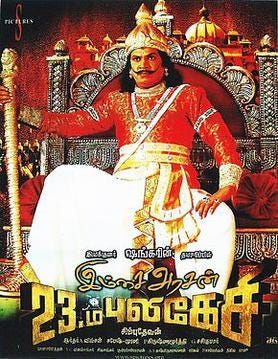

Imsai Arasan…, A cult comedy

Now, why horror-comedy has taken (is taking) so long to evolve? Simple. Even full length comedy has established itself only in the recent decades. Only in the A.D., comedy has been commanding a place for itself. Before Crazy, there were hardly any takers even for the evergreen material of slapstick or the comedy of errors. But just person (teamed up with a supreme actor) changed the pitch; and also the way games were played.
There have been directors and writers who have given us serial blockbusters. Ellis R. Dungan, B. R. Panthulu, S.P.Muthuraman, P.Vasu, Panchu Arunachalam, Gangai Amaran, Shankar and many more. It is a big deal. But to hand out guarantee consistent hits in just the genre of comedy — it is actually a big deal. When was the last time you just laughed so easily? (Unless the person cracking the joke was your boss.) Before Crazy there were just old sprinklers struggling to keep up the grass green. In A.D. the genre progressed from critically endangered to just vulnerable. A giant leap for any species. The genre blossomed.
Now, in the second decade of the third millennium, in spite of gems like Soodhu Kavvum (2013) we seem to be staring at a scenario of over-population. The makers are worried more about the numbers than about the DNA strength. But that is another story, unfolding every Friday. The latest, weakest member being Dharmaprabhu.
Maestro Ilayaraja — just a single person defined the whole of Tamil cinema music throughout the 1980s. Other than him there was perhaps no other person of any section in the industry, at any point in time, who stood as the only identity for his field of work; the one who had total domination. The sky always had a couple of shining stars and a few dazzling shooting stars. May be a rainbow here or a full moon there. But never a sole star glittering with a beaming smile. But from the year 1990, the comedy sky had one such star. It was ‘Crazy’ Mohan.

Don't Pause Your Life...

Once a while we all pause and take a good look around. It could be just for a moment or may be for a minute or it may last even for eternity. It all depends on what you saw first when you stopped. One of my friends saw his own shallow, mean life grinning at him; his pause continues even till this date — a good four years have flown by. A mind’s quest for meaning? I too had had a handful of such pauses, stillness and episodes of reflections in my life. I am not dead sure how long these pauses typically lasted, but the latest brake consumed a few long minutes. It came as a surprise when I opened my eyes and realised (and confronted) my fetish for bags. Well, here I am not talking about esoteric beings like, ,  , and so on that are mainly interested in elite females. I am more about the real stuff. The backpacks, duffel bags, messenger bags and the assorted ones that you find in  sale on a daily basis. But I must say life was so simple when all these animals were just classified as ‘shoulder bags’. But I had not relented, it seems. How on earth did this happen? When did I hit ‘Buy Now’ for a laptop bag the first time? And why did I not stop it even after the sixth instance?
Our brains have a smart way of processing the loads of sounds and sights that try to engulf us every second. The routine inputs of the eyes and the ears are just bunched and pushed over as the background. Once the noise is out of way we see and hear only those things that seem to be more important. If the bunching fails, we fail as functional humans. But the grouping does not guarantee accuracy or freedom from madness. In fact, on the contrary, I went mad confronting the dozens of cheap (economical, discounted) bags that fill my room; the bags my brain had pushed to the background. I am sick of them.
Only until the next big sale day in one of those online shops. Tote bags are so tempting. You just can’t have four.

(From the internet, By Linda Mears)
So I call up this semi-psychiatrist friend of mine who is yet to clear his solitary arrear. The paper that has been troubling him was on sleep disorders. But I bet there is no way he is going to clear it. He firmly believes insomnia is not a disorder, but a way of life — especially for a student of medicine. Now he takes a good look at my room, and expectedly his visual cortex is bombarded with the images of bags of multiple colours, shapes and designs; All of them dangling intimidatingly in the fan wind like crazy chimes performing a death dance in silence; His brain is unable to process it beyond a few seconds and he quickly gets out of the room, and shuts the door. He opens it again with the same speed and pulls me out.
Now he sits with me to know more about how it all began. Whether I had used bags during my school days or I just carried them on my head, and stuff like that. We do our usual chat for over an hour, but this time after his last sip of tea, he dramatically announces, ‘The session is over.’ I scratch my head. It did not make sense. He said, I (my brain) was full of ideas; that there was no stop for the constant stream of ideas my one hundred billion neurons generate. Sadly, my brain is unable to handle its own input as the synapses get into an inferno of tricky, unredeemable loop of self-generated stimuli. I stopped sipping my cup of tea. In shock. Forest fire ablaze between my ears? But luckily, he said, my brain has developed its own mechanism to handle it. And that is how I end up buying bags. Though his whole diagnosis felt like a Christmas cake made out of camel milk, I restricted myself to just one question — Of all things, my friend, my dear semi-psychiatrist friend, why bags?  also has deadly deals on digital clocks and designer umbrellas.
He was cool when he said — I bought only the bags and not cheap pyjamas or tooth brushes as I was unconsciously using the bags as containers to store the countless ideas that constantly oozed out of my brain like the infinitely tireless waves that lapped the shores of great seas, regularly powdering the huge rock here and the mighty mountain there, neither with remorse nor with vengeance but only with a touch of mechanical beauty in monotony.
He stressed ‘unconsciously’ and thumped the dining table almost shattering the tea cups when he announced it was a form of, hold your breath, 
Now, I am on the look out for the friend who is in search for meaning. May be he could help me. I also have things to discuss with my medical friend’s professor.

Super Deluxe (Film review)

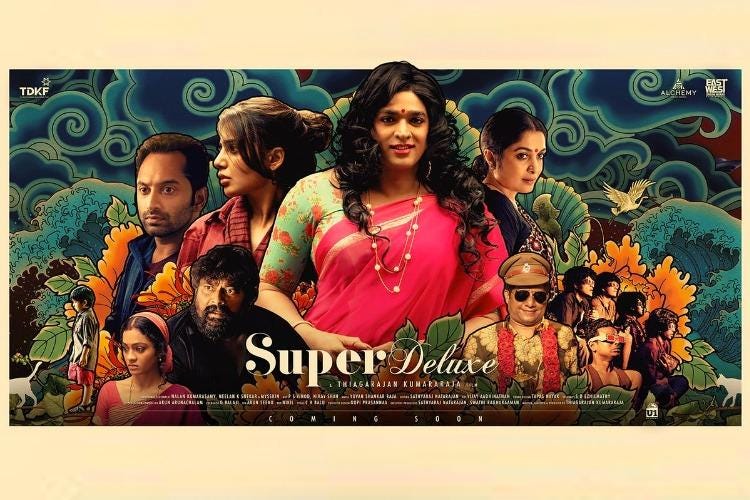
In his second outing, the avant-garde film maker Thiagarajan Kumararaja transports us to a queer world full of failing men and women, kids and a transgender, a dead body and other beings, and engulfs it with existential questions ranging from God to illicit relations to religious conversions to sex workers to fleeting social norms and so on. He also attempts to provide aswers through funny plots, witty dialogues and a few convenient cinematic devices. And the ultimate solution presented is — sex. It is said in clear terms by way of a B-grade Tamil porn film inside the film, Vaazhvin Ragasiyam (Life’s secret), that is juxtaposed in the movie’s ending scenes. Vaazhvin Ragasiyam starts, as the end credits of Super Deluxe roll.


Written by a team that boasts of three iconic directors of Tamil cinema including Kumararaja, Super Deluxe will be counted among the boldest attempts in Kollywood. Four different script writers have worked independently on the project. Boundaries are pushed constantly; new worlds get opened regularly. It is a unique experiment in Tamil cinema writing.


The film has three main threads — a quirky story that kicks of when a teen boy gets the shock of his life, when he sees his mother as the central lead in a 3-D porn film that he sits to watch with his classmates, a plot replete with dark comedy that takes off when a lady confesses to her husband that she had a fling with her ex in her own bed and well, the ex just breathed his last in the bed, and thirdly a moving story about a person who returns to meet his family after eight long years, and more importantly after his sex change. Got it?  All the stories kick off with events connected to sex, and they confluence and end with a sex film. So now you get a fair idea where this stuff is going to lead you, right? Wrong. The movie surprises you. But the glitch is with the way it does it — at times the turns look like either forced way too much or boringly long drawn.

Be it the initial scene where he tries to chop the dead body, or the place where he gets to know the cop is no more, Fahad Fasil has proved that he is an extraordinary talent. Same goes with Vijay Sethupathi. His (Shilpa’s) second sequence at the police station, where he struggles it out to reach the bad cop Berlin will be remembered for ages — both for exceptional acting and staging. Oh the bad cop! Bucks (actor) will be lauded for Berlin, and Berlin is the newest and the nastiest face of police in Kollywood. Film maker (also a co-writer) Mysskin also has delivered in his trademark style that leaves you confused and yet satisfied, with his authenticity fused with eccentricity. Ramya Krishan as Leela sparkles in the scene where she almost looks into the camera, as if asking to us directly, why there was no one to help her out. It is a question the society needs to answer. Samantha has tried to breathe life into Vembu, the lady who is geting killed from within by guilt. She has pulled it off in a very demanding scene set inside the famous, old mill of Tamil cinemas. Beautiful! Wonderful! Marvellous! But there seems to be an underlying basic tiff between Samantha and Vembu.

From the bunch of teenage lads who are on the run, to the assorted ones ranging from the school principal who does an impactful dialogue sequence with only one word, to Ramaswamy, the aide of a self-declared guru Arputham (Mysskin), the newcomers have done exceedingly well. The hero among the adolescents  the boy in the cat shirt, is perhaps the find of the year. He is like super cool from his initial scene where he asks for a packet of chips. But wait, there was this Raasukutty (Ashwanth Ashokkumar), the little boy who is too eager to welcome his father. The film belongs to this wonder kid whenever he appears on screen. And how can you forget the place where he talks with his father-mother from behind the closed doors. Just the kid’s voice Vs. Sethupathi draining himself out performing as Shilpa. Decide the winner for yourself.

Yuvan Shankar Raja has a limited role in the film that mostly banks on the ambient sounds ranging from that of a flying aircraft to off screen cats to a dead man’s fart. But wherever the composer had an opportunity, he has experimented in top gear. It is interesting, exciting too. A lot of story gets conveyed in the background dialogues. Quite a lot. Expectedly, there are no songs. But I am not sure of that. The film uses a few popular Hindi disco songs, which is quite okay, but like the film ‘96 (Tamil, 2018), SD also takes so much liberty with Ilayaraja’s songs that you do not get a feel of a song-less film. May be it is just a tribute to the Maestro, or may be it is an easy tool that has been deployed to elevate the script. (Can you think of ’96 without ‘Yamunai aatrile..’?)

Two cinematographers (Nirav Shah of 2.0 fame, and P.S.Vinod) have seamlessly worked to give their best output — which is why there is no one particular place where you could shout ‘The visuals were so good!’; the picturisation is terrific but it does not stand out separately from the overall film craving for your attention. Eyes do not take over your hearts and heads. And I think that is also successful cinematography. But yes, in the sub-way meet between Shilpa and Arputham, the cameraman (whoever it was) strives to capture your eyeballs. May be, he watched Agni Natchatiram(Tamil, 1988) the previous night. The setting and the art work looked as if most of the stuff bought for Aaranya Kaandam have been reused. All the places are uniformly and identically run down; Filled up with the same old stuff like a glowing globe here, a cassette player there, worn out wooden furniture, and the like. Hopefully they are disposing off the stuff now.

Easy Rider (English, 1969) propelled Hollywood into a new phase, in terms of bringing in fresh aesthetics on screen, presenting bold narratives, weakening the studio systems, and much more. Sample this conversation from the film —

“Don’t tell anybody that they’re not free, because they’ll get busy killing and maiming to prove to you that they are.

They’re gonna talk to you and talk to you about individual freedom.

But they see a free individual it’s gonna scare them.

Well, it don’t make them running scared.

No. It makes them dangerous.”

In Super Deluxe, Shilpa too prepares her kid with a similar talk. And the movie tries to stand by it; and almost succeeds too. Not entirely, because the film ultimately sticks to the billion-year old ending — Good should prevail; Evil must die. In this case the curse of a good woman brings about a terrible death of the bad. It is playing very much by the rule book. Nothing fresh or contra about it. But does it take away the credit from the experiment?

The film runs for close to 3 hours with a couple of redundant dialogues and stagnant phases. A tighter presentation would have made the creation ever-green and engrossing like AK. While Aaranya Kaandam was pure story telling, Super Deluxe aspires to be a philosopher with funny oddities.

Duper Seluxe!

Bonus read:

There is an edgy scene in a gully where Shilpa searches for her missing son. Here I’m not sure. I remember seeing a wall in the background with the words ‘Magic events’ scribbled on it with a contact number below it. (As in, a wall ad for a guy who perhaps arranges magic events for birthday parties, etc.) The very next moment, when Shilpa crosses the same place again, two new words, ‘Real life’, seem to have appeared above those two words. Let me know if I was hallucinating, or actually the film maker wanted to surprise us. SD presents us with such moments. 

Vaazhvin Ragasiyam’s film poster has an outline of a ‘door key’ as a part of its title design, apparently to mean it was the key that unlocks the life’s secrets;  Tastefully, throughout the film, a key dangles in the jeep the couple use to dispose off the dead body of the lady’s ex with whom she had just slept. Life’s secret, eh? 

The couple’s track, that of two cross fit personalities thrown into the same bed by the institution of arranged marriage and the painful path they have to tread to warm up to each other, is designed on the lines of Mouna Raagam (Tamil, 1986). It is nice to see that the maker has acknowledged this. The gesture is no small thing especially in a place like Kollywood, where even entire films get unofficially ‘remade’ — without even the slightest hint of gratitude.

The Queen’s Gambit (Review)

(Glad that my review got published in Readers Write  - Thank you so much Baradwaj Rangan! ) Streaming on Netflix and consisting of seven epi...