Showing posts with label Movies. Show all posts

The Queen’s Gambit (Review)

(Glad that my review got published in Readers Write - Thank you so much Baradwaj Rangan! )


Streaming on Netflix and consisting of seven episodes, each with a runtime of about an hour, The Queen’s Gambit could be termed as a coming of age drama of an orphaned girl who is a chess prodigy. Based on a novel by Walter Tevis, The Queen’s Gambit happens in the cold war years when the race between the USA and Russia spilled over to chess boards. (From Russia with love, anyone?) Set in the US, Elizabeth Harmon, orphaned after an road accident, gets admitted to an small town orphanage, where she is drawn to the game of chess. After much pestering, the genial old janitor, Shaibel agrees to teach her the game. And it does not take much time for Shaibel to realise ‘Beth’ is a chess prodigy, a sheer genius. The story unfolds over the next ten years or so of Beth’s life - her adopted home, her brilliance in the game, her troubles with relationship, her struggle with her own self and her meteoric rise in the sport that culminates in the world championship showdown in Moscow.  


Screenwriting for a character who is a genius in any field is expected to follow a template. Like, the onscreen geniuses are supposed to be eccentrics, mostly loners, persons who lack normal empathy and above all, men and women who cannot handle failures in their fields. Maybe that is the reality too. The writers of The Queen’s Gambit have used the same mould without any major deviations. An easy parallel could be drawn between the onscreen Sherlock Holmes, the genius investigator (Sherlock, played by Benedict Cumberbatch) and Elizabeth Harmon. You have Mrs.Hudson and Dr.Watson here too, but just that they are in different forms. But, while the characterisation per se does not break any new ground, the decision of the creators - of placing a girl-lady at the centre of a board game that symbolises human intellect and is still dominated by men - is simply brilliant, simply smart and more importantly, is not an easy one to make. Beth stands out, dazzles. 


Anya Taylor-Joy, as the grownup Beth, has not just breathed life and soul into the character but she has actually carried the entire series on her shoulders. Even within the limited bandwidth of emotions she is required to display, drawing from her hitherto unexplored resources as an actor, Taylor-Joy has given such a nuanced performance. Taylor-Joy has convincingly portrayed Beth, the super gifted chess player, as someone who oozes super cool confidence while at the same time as someone who tries hard to conceal her vulnerabilities. Not very often female actors get an opportunity to play such big roles; Taylor-Joy has made full use of the chance handed out to her. She is here to stay. 


Taylor-Joy has been supported exceedingly well by Bill Camp, Moses Ingram, Marielle Heller, Jacob Fortune-Lloyd, Thomas Brodie-Sangster and others, who play the roles of Beth’s coaches, confidants, companions and competitors in the dramatic life of the prodigy. 


Irrespective of the hardships and complexities, it is comparatively easier to shoot sports like racing or boxing. It is due to the mere fact that the very nature of these sports, packed with exciting action and a boisterous bunch of spectators, allows the audience to get connected with them easily. But with a game like chess in which the movement of the players is restricted mainly to their right hands coming up once a while, and where the spectators are expected to maintain pin-drop silence, it is indeed a tough task to create riveting visuals. Editor Michelle Tesoro and cinematographer Steven Meizler, getting solid support from composer Carlos Rafael Rivera, have worked wonders with their innovative shots and cuts. We are drawn into the game fully and there is never a moment of dullness. The high point being the presentation of the U.S. Championship tournament (Episode 5, Fork). It is such a beautiful and intelligent work.


What is the gold standard for an outstanding creation? The long and short of it is: None. But one of the metrics could be the way in which the creator spins a riveting tale out of normal ingredients - just like a magician pulling out cute bunnies out of a boring black hat right in front of your eyes in broad daylight. The sport of chess definitely does not belong to the league of attractive regulars like athletics or soccer, or for that matter even golf where one gets to at least see meticulously maintained landscapes dotted with fancy ponds, roving buggies and so on. And in the world of streaming platforms ruled by macho men in the form of gangsters, cops and kings, an orphaned girl as the central lead did not stand any chance - or at least that is what is presumed. But in The Queen’s Gambit, out of the boring black hat of chess boards and a lady as the lead, the creators Allan Scott and Scott Frank have pulled out something truly remarkable. Checkmated!

Forty Years Of Mahendran’s Rajinikanth And Sridevi-Starrer Johnny

(An improved version of this article got published in Film Companion. Thanks so much Team FC!)

It is ironic that a movie with Rajinikanth in a dual role and titled ‘Johnny’ is also among the most woman-centric Tamil blockbusters. It is also precisely why Johnny, written and directed by the legendary J.Mahendran, is ageless. Coming close to the hero’s another double role hit, Billa, a gangster film released on the Republic day of 1980, Johnny, the Independence day release, was at the other end of the sensibility spectrum. Unlike in Billa and other typical commercial films, in Johnny the female characters did not exist merely to decorate the screen. Instead, they move the story, they decide the action of men.

Johnny is a conman. But what occupies his life is - music. Right at the first scene Johnny is recording folk songs of the hills.  And till the end the love for music guides him. He admires and adores Archana, a lonely singer with a magical voice played extraordinarily by Sridevi. Admiration turns into love. Archana too needs Johnny. But his dark life does not allow him to take the relationship forward. Meanwhile, love blossoms in the life of a miserly barber Vidhyasagar, again played by Rajinikanth. Bhama is the girl. Her innocence melts his heart. But only till he gets to know her fully. Vidhyasagar ends up killing her. He starts hating women.  Soon, he comes to Archana’s home and starts living as Johnny, who is on the run by now. Vidhyasagar intends to exploit Archana. He repeatedly hurts her. Archana cries silently, she is confused - but her love for Johnny is unchanged. It is so pure. So how does the real Johnny and Archana unite? With a highly restrained yet powerful performance by the lead actors, the story unfolds gracefully and concludes in a beautiful way as Archana and Johnny come together to live happily ever after. Only a master like Mahendran, who had total clarity on what he was doing, could have pulled off such a feat. 


While normal screenplays struggle hard to achieve the desired character arc and yet languish, Johnnyeffortlessly presents it. Simply exemplary writing. Two couples. The first: a genuine man albeit with blemishes; an innocent lady. The second: a flawed lady; a man with blemishes but with a golden heart. Their lives cross. It is a writing that builds on the intelligence of the audience. The story just moves forward with minimal but impactful interactions of the characters. Every line uttered during the anchor scenes sound so simple and natural, but they bring to the fore the deepest bottoms of the characters. For instance, the place where Johnny and Archana have a chance meeting on the beach. The lines they seem to speak so casually - actually sum up their lives. Again, a master at work. There are many such gems - the scene where Archana proposes but Johnny remains helpless, the place where Vidhyasagar reveals his true identity to Archana and apologises. He concludes, ‘..I am barber by profession, murderer by accident, and now, because of you .. a human being. Thank you.. thank you very much!’ There is no melodrama, there is no build up. The lines are direct, and from the heart. And yet they elevate the art.


Johnny is also a film that tells us why Sridevi is well, Sridevi. It is easily one of her lifetime best roles. In the entire film she has only 3-4 pages of dialogues. That is all. And most of the lines are normal ones, not the usual cinematic ones like ‘Inum evalavu jenmamm eduthalum neenga thaan en kanavar..’-types. Yet, how she scores! Sridevi speaks more with her unsaid words. She expresses her emotional trauma convincingly - not by creating a ruckus but merely by - holding back tears from rolling down her cheeks. Archana is the soul of Johnny, and Sridevi gives life to Archana.


To this date Johnny stands out in Rajinikanth’s filmography. It is one of the last films to bank solely on the acting skills of Rajini. Murattu Kalai, released in the same year after Johnny, catapulted Rajinikanth into Superstardom. The hero’s trajectory changed forever. Barring a few exceptions like an Enkeyo Ketta Kural or a Sri Raghavendrar, Rajinikanth never looked back and till this date keeps rolling out revenge dramas, replete with hero intro songs, heavy duty action, style with cigarettes, punch dialogues and catchy mannerisms and so on. Basically, all the Rajini things. Collaborating for the second time with Rajinikanth after their earlier outing Mullum Malarum, this time Mahendran upped the challenge for the actor with a dual role. For his part Rajinikanth gave a memorable performance, especially as Vidhyasagar the stylish, reclusive barber who undergoes a series of tribulations. Love. Betrayal. Murder. Deceit. Realisation. Sacrifice. The character has a great range and depth. And Rajini sparkles as Vidhyasagar. In spite of his daring conman acts, the Johnny character needed to subtly display an underlying sense of vulnerability throughout the film. Rajini pulls it off too. Just sample the scene where Archana proposes to Johnny.


(Mullum Malarum, the duo's earlier outing)
 

The film has a limited number of characters and among them Suruli Rajan gets a considerable share. With his peculiar voice and funny body language, the actor provides a solid support to Rajinikanth, especially in the initial scenes. There are a few light moments. Bhama is very central to the film. Bhama’s innocence attracts Vidhyasagar; Her betrayal turns him into a killer. Deepa, as Bhama, has deftly handled the role. It is a wise casting decision too. Not many lady actors could perform negative shades comfortably. 


Just like with his many other films, Ilayaraaja compliments as well competes with the filmmaker, delivering songs and background score of a superior quality. As they say, it is tough to believe that one man could do so much. The movie has five songs, and out of them only one has a male singer. Again, stressing the woman-centric nature of the film. ‘En vaanile..’ by Jency is among the greatest melodies of Ilayaraaja and it keeps engrossing FM radio listeners even now. ‘Oru iniya manadhu..’ by Sujatha is another powerful melody that is capable of transporting us to a different world. ‘Aasaya kaathula ..’ by S.P.Shailaja still sort of haunts us. It has a Hindi avatar as ‘Stereophonic Sannata..’ from Shamitabh (2015). ‘Kaatril endhan geetham..’ by S.Janaki is a landmark climax song in the annals of Tamil films. But beyond the song, the beauty of film is that even as the long separated hero and heroine meet, soon after the song, they do not utter even a single word. Ilayaraaja’s music takes over and the film ends with the caption ‘Music The Life Giver’. 

Gained in translation — the best remakes in Tamil Cinema

An improved version of the article is published in Film Companion. . Super :) Thanks to the FC Editorial. 


Remakes are tricky. To make successful remakes it is not enough if you are good at cloning, you should have mastered the art of migrating souls too. Take for instance Dayavan, the Hindi remake of Mani Ratnam’s masterpiece Nayakan. While Nayakan is a milestone in Indian cinema, Dayavan is languishing with an IMDB rating of 6.5/10. So what went wrong? In Mani Ratnam’s own words, Nayakan is a story of ‘an underdog’s conquest in an alien zone’. But the whole thing fell apart when Dayavan was set in Mumbai, a familiar territory for the characters and the Hindi audience (Conversations with Mani Ratnam by Baradwaj Rangan). The soul is shattered. Similarly, Sujoy Ghosh’s acclaimed Kahaani did not live up to its standards in its Telugu/Tamil version. Kahaani is about the travails of young, ‘pregnant’ lady in search of her missing husband, and how overcoming all odds she outwits the system filled with dangerous men. Cut out the word ‘pregnant’ and you have just one more Sathyavan-Savithri story. And that is what precisely happened with the remake. The soul went missing.


With the fairly well made Dharala Prabhu (Tamil remake of Vicky Donor, Hindi) streaming on Prime now, here is a look at a few films that took successful Tamil avatars.

Adithya Varma (Arjun Reddy, Telugu) … Taking bull by the horns
Arjun Reddy (Telugu) was a controversial, commercially successful, cult film that banked on the talented actor Vijay Devarakonda. The seasoned Shahid Kapoor too justified his part in the Hindi version, Kabir Singh. The film is about a medico who is basically a raging bull that thinks the girl he likes is his property. The movie lapped up fans and haters alike. To even attempt to use a film with this history as an acting debut is itself something intriguing. But you have to give it to him — Dhruv established right in his very first film that he is someone who has it in him, and someone who is here for the long haul. Waiting to see more of him… Also eager to watch the first version of the film, Varma, directed by Bala and abandoned.

Thillu Mullu (Gol Mal, Hindi) … Comedian Superstar
It is not totally wrong to say Rajinikanth and the aura around him was built by remakes. Some of his greatest ‘super star’ films like Billa, Thee, Naan Sigappu Manithan, Mr.Bharath, Panakkaran and Muthu are all remakes. Even his comeback film Chandramukhi was a remake. But one film that stands out is Thillu Mullu — Rajinikanth’s first full length comedy film. Until then the star was majorly into ‘action’ mode. But Thillu Mullu, helmed by the legendary K.Balachander and written by Visu, presented us an unexplored facet of the Superstar. Sowcar Janaki and Thengai Srinivasan (as the rib tickling, gullible manager Sriramachandramurthy) lend a solid support to Rajini in this film that is basically a comedy woven around the impersonation of a non-existing twin brother. The movie also has Nagesh (playing himself) and Kamal Hassan (also playing himself) in guest roles. The plot and performance made sure that Aiyampettai Arivudainambi Kaliyaperumal Chandran is remembered even to this day; And Rajinikanth stood not just for style and stunts— but for comedy too.

Sathya (Arjun, Hindi)… The angry, young Kamal
Papanasam, a successful remake of the Malayalam film Drishyam, was a treat for film aficionados who had a rare chance to directly compare and cherish the output of two masters of our times — Kamal Hassan and Mohan Lal — scene by scene. Kamal’s other important remakes are the laugh riot Vasool Raja MBBS (Munnabhai MBBS, Hindi), social thriller Unnai Pol Oruvan (A Wednesday, Hindi) and critically acclaimed, performance packed  Kuruthipunal (Drohkaal, Hindi). But Sathya easily outshines as the best remake by Kamal yet. In this angry, young man story the actor with his new get-up — of short hairdo, untamed beard, steel kada and sleeves rolled up till the biceps— set the screens on fire. Sathya Kamal was a nothing less than a thunder bolt. The film has a lot of light moments too like the one where Sathya’s Keralite girlfriend Geetha takes him to her home, and soon Sathya catches her aunty off guard with his Malayalam skills. Sathya has one of the ageless melodies of maestro Ilayaraja. Even in the year 2020 Valai oosai… pours love and melts hearts. While there have been many directors who started off their careers with block busters, only a few have been lucky enough to launch themselves with cult films. With Sathya, the debut director Suresh Krissna joined the elite league.

Nanban (3 Idiots, Hindi)  … Follow your passion
Director’s Shankar’s only remake yet, till its release Nanban kept the audience wondering how could a mass hero like Vijay pull off a film that does not have— an intro song, flying cars, exploding bombs, ‘loosu ponnu’ heroine and deadly villains with thick moustaches. (And the very fundamental question of how could Vijay fill in the shoes of Amir Khan?) Fortunately, for all of us the film worked. Given that Tamil Nadu has a mind boggling number of engineering colleges, Nanban was a much needed film in terms of the message it had. The film also deglamorised the stars and brought meaningful as well entertaining scripts to the centrestage. For the top heroes of the industry Nanban showed a new approach to blockbusters. But sadly, it was just an aberration as even Vijay himself got back to his comfort zone filling his box with Vijay-brand of films like Jilla, Bairavaa, Thalaiva and so on. 


Nerkonda Paarvai (Pink, Hindi)… No means No!
It took everyone by surprise when it was announced that Ajith Kumar would be reprising Amitabh Bachan’s role in Pink. The wonderfully written Hindi film, directed by Aniruddha Roy Chowdhury, did not have scope for foreign songs or Yogi Babu; also the film did not exploit any of the ready-made sentiments like brother-sister bond or organic farming. The film was about how a reclusive, old lawyer takes up the case of three young women who get entangled in a series of torments that take root from the way our society perceives women. While 3 Idiots made us to reflect on our education system, Pink touched a very raw nerve of our patriarchal mindsets. Great films are the ones that present us a new dimension of ourselves; they make us see ourselves in a new light. Pink was truly a great film. It exposed us. Directed by H.Vinoth, Nerkonda Paarvai stuck to the original, even if it meant running the risk of getting tagged as an ‘urban’ film. But the movie was a bumper hit. Ajith Kumar excelled in this film that was essentially a court room drama, with a very limited number of characters. Rangaraj Pandey, a journalist, too proved his mettle as a fine actor. Though a stunt sequence was force fitted into the script, luckily, it was not allowed to run amok. The film effectively delivered a message that was very much needed; And it becomes special when the ‘ultimate star’ delivered it.

Kadhalukku Mariyadhai (Aniathipravu, Malayalam)… Pure love
Those were the formative years in Vijay’s career and he was doing 4–5 films every year. While many were also-rans, a few of them glittered. Released in 1995, Vikraman’s Poove Unakkaga is one of those initial films that made us take Vijay seriously as an ‘actor’. The very next year, the actor enriched his portfolio with Fazil’s Kadhalukku Mariyadhai — one of the most beautiful love films in Tamil. A remake of the director’s own Malayalam movie, the story is as simple as a circle: the boy and the girl fall in love, the elders object, the pair struggles and finally it ends happily for all. But the way the story is taken forward - with smooth, natural dialogues backed up with neat performance by a dozen proficient actors like Srividya, Sivakumar, Radha Ravi,  K.P.A.C.Lalitha, Charle, Manivannan and others - just bowls you over. Vijay-Shalini pair had an extraordinary chemistry that sustained throughout the film. Unlike the usual love films, in KM the lead pair did not have any ‘romance’ scene; even in duet songs they maintained a safe distance. Still the pair worked magic — simply by the way they conversed with each other, by the way they missed each other, and by the way they just looked at each other. Pure love oozed. Maestro Ilayaraja carried out his routine of making a film transcendental with his compositions. But the album had two unusual things — Vijay crooned a peppy, easy-as-breeze number and established himself as a bankable hero-singer; and it did not have S.P.Balasubramaniam. Films like Kadhalukku Mariyadhai make us wonder what goes wrong as stars rise, and why they forget how they won the hearts in the first place.

Remakes are almost as old as cinema. But the early remakes were happening within the Hollywood. Like the same way Thillu Mullu was remade in Tamil, or more recently the remake of The Lion King. Though there were remakes of non-English films like Seven Samurai (Japanese) into English, what really made everyone turn towards the world of remakes was the legendary Martin Scorsese’s crime thriller The Departed (2006). A winner of four Academy Awards, the English remake tactfully migrated the plot from Honk Kong City to Boston, from Cantonese to English, across half the globe—without spoiling the fabric of the original. But if the soul is not preserved the remake of even a song might get really troublesome as seen recently in the case of the Delhi 6’s remixed number Masakali..Masakali…

Apoorva Sagodharargal (1989)… still the pinnacle of Kollywood masala

Baradwaj Rangan published this article of mine in his blog. Super thrilled!

April 14 is the Tamil New Year's day. It does not change every year. And ever since its release on the Tamil New Year’s day of 1989, Apoorva Sagodharargal too hasn’t changed its position as the best-ever Kollywood masala. And here’s why…

It is just a plain old revenge drama with a simple premise - two long-separated brothers come together to avenge their father's killing. Can it get simpler? The film deploys the usual tools of masala that are available to a mainstream film maker - mother sentiment, pregnant lady sentiment, love tragedy, brutal killings, rich girl-poor boy romance, comedy, deadly villains, funny cops, good songs and stunts, and finally a happy end. The characters are either black or white. There are no grey shades to transcend the script. No unexpected twist anywhere. It is a very straightforward narration. Still what a magic on screen! 

The movie has a placid start with a close shot of a duck in an idyllic village, only to throw us onto a racy trajectory with a jeep ripping through a thatched hut like an arrow tearing a tender heart. The action block goes on with the father-police inspector Sethupathy (Kamal Hassan No.1) stealing the limelight - behaving like a roaring lion with the foursome villains and at once turning into a naughty kitten with his pregnant wife (Srividya). Very soon, within a matter of 12 minutes, everything is over: Comedy icon Nagesh gets established as a barbaric villain with a sharp humour, a star from the yester years ‘James Bond’ Jaishankar joins him; the villains are arrested and disgraced by Sethupathy; but court acquits all of them while throwing the upright inspector out of job; it is the villain team’s turn and they ravage the beautiful couple within moments after the couple had shared some lovely moments; Sethupathy is killed mercilessly right in front of his heavily pregnant wife; and the title credits keep rolling as the poisoned, pregnant widow escapes on a boat, with maestro Ilayaraja giving out one of his best background scores.
Only a few other movies have reached this level of screenplay in establishing so much, so tightly, in just about a dozen opening minutes. Even the sheet anchor scenes of Thalapathi (1991) shot in black and white - of a teenage, unwed mother abandoning her just born baby in one of the open bogies of a goods train; the baby being rescued by some kids only to be accidentally let to float in a stream; and soon the baby being regained from the flowing water and he growing up into a dejected, angry little boy with a single question that resonates throughout the movie 'Why did my mother abandon me?'' - that run for the initial ten minutes as the titles roll, and which are equally backed by Ilayaraja's masterpiece melody, are a shade lesser than that of Apoorva Sagodharargal’sprelude scenes. 

Into the story, after lots of fun and a love tragedy, the mother reveals their brutal past to Appu (Kamal Hassan No.2) who just tried to commit suicide; and the dwarf-clown instantaneously decides to take revenge. Bloody scenes of Sethupathy getting killed are intercut here reminding us the brutality. And for Appu it is not just about avenging his father’s killing, it is also about eliminating those who were responsible for his stunted growth which gives a constant reason for others to mock at him. It is just smart writing by Kamal Hassan. But a single thought lingers in our minds - how is this little clown going to hit back at the four villains who were nothing less than devils. May be Raja could have pulled it off. But not this dwarf! Interval is something peculiar to our masala films. It is not easy to break the standard three-part story structure and create an interval block in the first place; and thereafter make it compelling too; riveting enough to make the audience finish their coffee and cigarettes quickly and get back to their seats filled with anticipation and curiosity. Apoorva Sagodharargal pulls it off in style. 
The second half is about how the Lilliputian goes about killing the villains - using novel, believable but essentially cruel methods. But the movie carries itself so well that we do not watch those gory scenes through our fingers. We kind of relish them. Sample this: of all things in the world, to kill his second target Appu uses his circus tiger to tear up the man into pieces. (Wait, wait… lions are reserved for the climax.) This scene of an extremely cruel murder transforms smoothly into a peppy number with the car mechanic Raja (Kamal Hassan No.3) performing puli vesham (tiger costume) folk dance. And in between this quick and enjoyable transition is ample humour by Janakaraj, as the investigating inspector and his sidekick constable, Sambandham. Neenga engeyo poiteenga sir! And Kamal Haasan, the ingenuous script writer, in an attempt to achieve the desired scene shift with flair, has also used 2-D animation here. It is funny, it is creative. 
In the scenes in and around Appu's love failure, the actor Kamal and the maestro compete terrifically with each other. These are a set of rare scenes in cinema, that work equally good - without audio or without video. Even when you mute the music and just watch the film, the actor's sheer brilliance makes you cry for Appu whose soul gets shredded into pieces by the tragic end of his love. Well, you have the same effect even when you close your eyes and simply let yourself get immersed in the heart wrenching melody. It is like two superior players easily winning the match on their own, yet preferring to come together - not just to win, but to create history. But not that the dialog writer ‘Crazy’ Mohan was just a mute spectator here. The humour played out in this very tragic scene is unmissable. The marriage registration officer mocks at the dwarf Appu, only to be sort of defended by Appu saying that he was 27 years of age (basically, a man and not a kid). The officer mocks and laughs out, ‘Yedhu.. andha irupathi aarukku appuram varumey.. andha irupathi yezhaa?!’ What a pain. What a humour. The writing and dialogs puts you in quite a few tight spots like this where you are at a loss to understand your own state of mind. It happens when pain and joy blend, when comedy and tragedy dance together. 
Lyricist Vaali's versatility is legendary. In Apoorva Sagodharargal he proves his worth hands down. Sample this: Andha vaanam azhudhathaan indha boomiyey sirikkum.. oozing with pain, a sinking heart. Vazhavaikkum kaadhalukku jey! Vaalibathin paadalukku jey!.. pumping love and joy, carefree souls. The visuals too match the high quality of lyrics and music. It is quite interesting to see a dapper Raja dancing his intro song in the shop floor of an automobile factory filled with rows of newly minted cars and trendy girls. The biggest dream of a small time car mechanic, possibly. The same goes for vazhavaikkum song that is made a part of the story, rather than just existing in empty space. Perhaps it is the only full-fledged duet song in Tamil film history that features a dead body too!

The movie never loses sight of its 5-song/5-fight format of a mainstream masala. After all the story was by the legendary Panchu Arunachalam, the man to whom Kollywood owes half its wealth. But the film demonstrates the possibilities in store when an A-team decides to create something unique and more importantly - when all of its A-rated members fly in unison. This is not a movie where you can easily point out, "The music is wonderful!" and rest. With this movie, you cannot leave out P.C.Sriram when talking about Ilayaraja; you cannot miss ‘Crazy’ Mohan when mentioning about the scriptwriter Kamal Hassan or the lyricist. The same with the actors like the inspector Janakaraj, mother Manorama and the villain team that includes the Kamal-regulars like Nasser and Delhi Ganesh. That is the beauty of Apoorva Sagodharargal. It is quite a task to dissect a scene and say authoritatively who has excelled. We get a wholesome, new cinema experience. And that is what the team set out to deliver.

But if I were to single out a person who raises above the rest, it is probably the cinematographer P.C.Sriram. Appu looked like a dwarf; he was a dwarf! No animatics, no 3D modelling, no roto. Sheer old-fashioned camera tricks, real hard work and some great ideas. Yes, the DOP had a solid support from the actor and the editor duo B.Lenin and V.T.Vijayan. But the brain of the movie ultimately is P.C. An angle missed here or there would have made the entire movie like a high school stage drama. (Remember SRK from Hero? Well…) Even to this day, the making of Apoorva Sagodharargal awes everyone around, it continues to be enigmatic. 
Great movies are made bottom-up and it requires an able hand to weave the individual threads of artistic brilliance into a magnificent cinematic experience. Hats off to director Singeetam Srinivasa Rao. It is not easy to manage talent. It is extremely difficult to manage extraordinary talent. Luckily, the project was in very safe hands. Over the years hordes of heavy weight masala films have hit the screens; like the corruption-based Shankar brand of block busters, village-based K.S.Ravikumar creations, P.Vasu class of pictures and A.R.Murugadoss and Atlee style of well packaged super hits. What is a masala movie? It is not easy to define. What is a successful masala? Even tougher to describe. But whatever it may mean, Apoorva Sagodharargal is the most successful masala of Kollywood since its release; the run continues even into the Tamil New Year of 2020.

(Bonus 1 - A deleted song ‘Ammava Naan..’ from the film is on Youtube.)


(P.S. - It is good for the film that Bahubali was not made in Tamil.)

Here is the link to my earlier piece on the film. I wrote it five years ago. 

Five years of OK Kanmani

An improved version of this article was published in Film Companion. . .What is more exciting is that the article was chosen for publication by Baradwaj Rangan, Editor, Film Companion (South), a winner of the Best Film Critic National Award and above all an authority on Mani Ratnam.


O Kadhal Kanmani (Apr, 2015) ended the legendary Mani Ratnam’s 15-year long dry spell in Kollywood. The film maker had touched new lows consistently with back to back creations in the form of Ravanan and Kadal. While Ravanan was pardonable as it was essentially a slice from the classic Ramayanam, Kadal was a mutation that went wrong — a new species that did not know how and why it got created in the first place. The world could have been a better place without that. In short, Kadal was an evolutionary confusion. And it was then, much to our relief, OK Kanmani sprouted from the primordial Mani Ratnam material

What is the most used thing in a Mani Ratnam film? Yes, mirror. What is the next one? Of course, train. In the very first scene of Kanmani we see a train chugging into the Mumbai’s CST; hero Aditya (a refreshingly urban Dulquer Salmaan) arrives; right then through the gaps in the coaches of moving trains he notices the heroine Tara (a bubbly Nithya Menen) almost on the verge of jumping in front of an oncoming train. Tara just had a spat with her boyfriend. It was about their marriage. With P.C.Sreeram joining hands with the director, again after a gap of fifteen years, the beautifully shot scene directly places us inside the Mani Ratnam kingdom. Well yes, the eyes too meet through the gaps in the moving trains.

Who is a cryptologist? While the normal guys are intimidated by the term, Mani Ratnam fans love a cryptologist, who is basically someone like Avind Swamy in Roja. Now it is the turn to introduce another new job position in Kollywood — a video game developer. (Detour: My earliest memory of an on screen video game developer is from 101 Dalmatians, 1996) If Karthik (Alaipayuthey) could be a software engineer in the dotcom times of 2000, Adi should be a video game developer in 2015. Simple. Linear career progression. But it works. And what is the game that he develops? Mumbai 2.0. (Mani 2.0?) Desi game, for desi kids. And the game too starts in a Mumbai local train. By then Kanmani is already an overdose of the familiar Mani Ratnam delicacies. But that is what we had been craving for. Hang on, soon just like in Alaipayuthey, the hero-heroine meeting happens in a wedding. And within moments they talk about their idea of love, marriage, family and life — in a few short sentences. 


The first ‘Mani Ratnam Film’ as in ‘a Mani Ratnam Film’ was Mouna Raagam. Released in the year 1986 the film held a mirror to the tradition of arranged or forced marriage that is a common practice even now. The story is about the how a lady who gets pushed into a married life struggles; and how she goes on to find love and meaning in her new role as a wife. Though her husband is a nice guy, she starts off with a divorce notice — but ends up getting transformed into a caring wife. It is about nice people finding the right perspectives and getting nice to each other under one roof. . . Happily ever after! Mouna Raagam was a huge hit, and in fact the film gave us ‘Mani Ratnam’. After successfully venturing out in a variety of subjects like underworld, biopic, patriotic stuff, kids drama and Kollywood masala, in his own trademark style, the film maker got back to his ‘nice people getting nice to each other’ mould with Alaipayuthey. While Mouna Raagam explored the subject of arranged marriage, Alaipayuthey was about love marriages. It showed even love marriages could get screwed up badly if the love and care gets lost down the line. Love marriage or arranged marriage, only love wins. (But the final destination was always a marriage.)

Again venturing out in different genres in Kollywood, mostly without success, the emperor struck back with OK Kanmani. This time too, only love won. But adapting to the times, rather than exploring ‘love’ and how it should be made to work in the tradition of wedlock, Kanmani finds a sweet spot in ‘live-in’ relations. Mani 2.0. Live-in relation was not something new to Tamil cinema. If you think of it, the concept of live-in was embedded in Apoorva Raganagal (1975). Stretching too far? Okay, but no one can deny it was a live-in relation in Karthik Subburaj’s debut Pizza (2012). But with the magical touch of Mani Ratnam the idea of live-in got fancier and more mainstream. 

Kanmani is replete with the usual seemingly quirky dialogues and beautiful ‘romance scenes’ that have been the director’s forte. Can’t help but awe that he had maintained his brand over the decades; the golden touch, with regular updates. Just watch the trailer of the film and you will get a hint of what I am talking about. In the lines just after they make out for the first time, the lady asks: Enna pudichirukka..?..illa indha kasa-musa thaana? He says: Kasa-musa pudichiruku.. atha thaandi unnayum konjam. Just konjam! Onnu-aaru rooba pudichirukku..  Can you believe it? 

The contour of the screenplay too is set up wisely. Firstly, the basic concept of ‘live-in’ is explained (to Vasudevan played by Prakash Raj, representing the old generation), then a character belonging to the middle age-generation (Saroja, sister-in-law of the hero) opposes the concept, then we have the gen-z (Tara and her friend) discuss the dos-and-don’ts of a live-in and the final part of the screenplay — resolves the complex intersection of love-wedding-individuality without turning preachy. 

The film was loaded with the film maker’s trademark elements of strong female characters, beautiful romance, tasteful visuals, wonderful songs and music, bold and enjoyable scenes, two-word dialogues, mirrors, trains and rain, songs that carry the story, dry wit and above all a ‘socially acceptable’ ending. That’s how OK Kanmani, brought us back the Mani Ratnam film we had been longing for since the year 2000. It was more like cherishing the pages of your college slam book or an old photo album — remastered. May be it was Mani Ratnam’s modern day interpretation of his own Alaipayuthey. Plainly, just an intelligent rehash of his own earlier works. But whatever it was — O Kadhal Kanmani was a thorough entertainer. A whiff of fresh air. 

Raghuvaran — Why The Spot He Occupied In Tamil Cinema Is Still Vacant?

(This piece was published in Film Companion)

My oldest memories of the lanky actor with a distinctive voice, Raghuvaran (1958– 2008), are from the films Makkal en pakkam (1987), Poo vizhi Vasalile (1987) and Puriyaatha pudhir (1990) of the ‘I know.. I know’-fame. In the film Raghuvaran is a sadistic, doubting husband and in a situation he thinks he has caught his wife off-guard. Now, for the film maker there are very direct and good options here. The easiest of them is to make the husband lecture about our value system, get violent towards the wife or even kill the guy. But that is ordinary writing for actors with normal talents. But with Raghuvaran the entire scene running for about two minutes gets elevated with just two words — ‘I know..’ It is said while a musician communicates feelings through the instrument he is playing, a dancer through body movement, the ‘instrument’ that an actor is using is himself (Making Movies by Sidney Lumet). Raghuvaran demonstrated that. 

In Samsaram adhu minsaram (1986), Raghuvaran as Chidambaram the eldest son, was pitted against the veteran Visu playing Ammaiappan Mudaliar, the patriarch of a typical Indian middle class family. The film had a host of characters. But the story conflicts were created around the Raghuvaran-Visu duo. It was an equal fight and Raghuvaran shone bright. By then the actor was a bankable character artist though his career was leaning more towards the villain end of the spectrum.

Mani Ratnam’s Anjali (1990) a family-kids’ drama surrounding a special child drew from the vast reservoirs of acting skills that Raghuvaran possessed. In the film as Sekhar, a nice guy who handles the emotional pain and love that the entry and exit of a special child with a terminal illness brings about in a family, Raghuvaran gave his trademark performance with much grace. But around the time, the actor’s image as a dangerous villain got cemented. Thanks to Ram Gopal Varma’s cult film Shiva (Telugu, 1989).

In the 90s though there were occasional gems like Aahaa..! (1998) that brought out the versatility of the actor, the decade marked the clear shift from Raghuvaran the character artist to Raghuvaran — the undisputed lord of the villains in Kollywood. It was also the time when the seasoned Nasser had peaked as the most hated villain in Kollywood with films like Thevar magan (1992) and Kuruthipunal (1995); and he not only started venturing into more varied roles like in Avvai Shanmugi, Bombay, Iruvar and Jeans but also turned a film director with Avatharam.  

During the decade Raghuvaran featured as the bad guy in big ticket films like Ratchagan, Shankar’s films like Kadhalan and Mudhalvan, and a few Rajnikanth films like Baasha, Arunachalam and Muthu. But he was not your regular villain that smokes a pipe, rapes hero’s sister, mouths a catchy phrase and finally gets killed by the hero. He was a villain who set the boundary limits of the hero; a villain who built the hero; and a villain who created a world for the heroes to rule. 


In the Superstar’s iconic Baasha (1995), as Mark Antony the actor catapulted Rajni’s stardom to an altogether new plane. The film renewed Rajnikanth’s cult status easily by 3–4 years till Padayappa almost came close to doing it again. Baasha was Manik Baasha only because Antony…Mark Antony was Raghuvaran.

Mudhalvan (1999) saw Raghuvaran play, unarguably, his best villain role. While Baasha was no less, but being a Rajni film it had its own constraints. Ultimately people poured into the theatres for Rajni alone. But with a lead artist like Arjun, and a fairy tale-type script that placed the corrupt and cunning chief minister Aranganathan central to its plot — Mudhalvan must have offered Raghuvaran a feast. A full meals to quench his hunger to perform strong characters; a challenge to harness his acting potential to the fullest. Raghuvaran (then about 40 years of age), with intelligent voice modulation and body language modifications, performed as a much older political leader. Again, an actor using his body as an instrument. The controversial interview in the film that sets the entire story in motion is among the most cherished scenes in Tamil films. And if you look the scene closely there was also Arjun as Pugazhendi. You tend to miss him— simply dazzled and overwhelmed by Raghuvaran-CM. (Not to take away credit from Pugazhendi, the newly-promoted journalist who was doing his first VIP interview.)

The 2000s saw the fading of Raghuvaran as an actor. The number of movies he did dwindled. The roles he bagged too were not the ones that he would have really wanted to do. Many roles did not need him either. But there were occasional exceptions like Run and Yaaradi nee Mohini (April 2008), released within a month after his untimely demise. During the decade Raghuvaran also did passable roles in a few mega budget films. But he always left his mark. Do you know Raghuvaran has acted in Rajnikanth’s Sivaji? It is also glaring that there was no (notable?) collaboration of Kamal Hassan with Raghuvaran. Plainly unfortunate for Tamil cinema; for us. 

Around this time Kollywood witnessed the meteoric rise of another gifted actor Prakash Raj. He seemed to be the new Raghuvaran on the block; a versatile actor capable of doing roles as varied as a legendary political leader (Iruvar) or a dreaded village goon (Ghilli) or a possessive father (Abhiyum naanum) with equal deft. Prakash Raj also sparkled in comedy films like Vasool Raja MBBS. 

But the position of a villain with exceptional craftsmanship and a unique voice is still vacant…

(Special thanks to Team FC editorial)

Darbar (Tamil movie, English review)

Darbar is a film that works at all levels - right from music to action blocks to costumes, et al. But the only trouble with the film is that it has come with a delay of some 4-5 years. There was a big question mark in the Superstar's career after Linga (2014). Ideally, Darbar should have been released around that time - just to prove that the Rajni magic was still as strong and as addictive as ever.  But now, as a Rajni film coming up immediately after the well written and beautifully crafted Petta (2019), Darbar is something that even Rajni could have avoided. Petta had already achieved what Darbar purportedly attempted - to celebrate the ageless Star. And it had achieved that with a great panache, and more importantly in tune with the changing times. 

Aditya Arunachalam, played by Rajnikanth is the COP, Mumbai. He gets transferred from Delhi to Mumbai by someone dressed in a bandhgala suit sitting in a huge well furnished hall. May be he is some sort of an All India Commanding Officer. Well, here we stop and tune ourselves as if we have come for a mass Rajni film like a  Rajathi Raja or a Sivaji. Fair enough. If I am to get something extra by sticking to the usual route of suppresing our logical sense while watching a Rajni film, I am more than willing to do that. Naturally, because that is what we have been doing over the decades. But, the key phrase here is - 'something extra'. 


The first half of the film is pretty good. It has been written well, and it succeeds in checking all the critical Rajnism boxes - style, stunts and comedy. The chemistry between Aditya and his daughter Valli (Nivetha Thomas) has worked out very well on screen. In fact, the father-daughter relation holds the film throughout. Yogi Babu as the COP's PA has supported Rajnikanth neatly with his funny lines and antics. Nayanthara (Lily) as the hero's love interest has justified her role, which demands only a limited range of emotions. It is a cake walk for her. May be she is doing such a role for the zillionth time. But luckily, all of us are spared a full fledged 'duet' song. And the age gap factor of Aditya-Lily too is handled in a nuanced way. Hats off!

So far, so good. On the story front, the first half revolves around certain drug-related crimes ultimately leading to a petty criminal doing 'proxy' time in prison, in place of the real master mind. Aditya rattles the plan with a lot of brain work. The script is gripping around this sequence. By the interval the COP is extraordinary. Rajni at his near best.

In the second half,  the movie takes off well but just when you are all set to see the heights the script is going to take you, it starts meandering and worse - falls back to the very old formulaic things. The very stuff that the stars are trying to put behind them. It is like beyond a point the team decides - Relax baby!  It is the auto pilot time! It is a rehash of many things old and beaten. The music too sounded pedestrian and at many places it was a rehash of Thenisai Thendarl Deva's tunes. (His name finds a place in the initial 'Thanks'.) Anirudh's golden touch is by and large missing. 

But if there is one thing (basically there is only one thing) in the film that stands out - it is Rajni's effort. He is just amazing, defying age with elan. Believe me! Be it the one liners, slo-mo style walks, dance, humour and above all the fight sequences - the Superstar has delivered superbly. The climax stunt will be talked for many months to come. There is not a single place where the actor has let his guard down, or just tried to 'manage' his performance. It is tough not to envy him. It is tougher to find a comparable star anywhere around the world. But it is also a tragic truth that even the best of the stars cannot entirely salvage a script that cries for more attention. 

A Brief History of Tamil Comedy Films: From Before ‘Crazy’ to A.D.

Muni Cinematic Universe. Yes, that is how the Muni-Kanchana series of horror-comedy movies have come to be referred. The first installment Muniwas dished out in the year 2007. And till this date the makers continue to entertain (and terrorise) us with their flavour of comedy. Kanchana 3 wasthe biggest hit of the summer of 2019. It was the fourth film of the MCU. Amidst this, we also had a neat horror comedy in Darling (2015). But for an industry that has been around for 100+ years, why are there only a few takers for the niche genre?

In the initial years (1930s and 40s) Tamil films mainly said the stories from popular Hindu myth like Baktha Prahalada, Meerabai, Harichandra and so on, and various sub-plots of Ramayana, Mahabharata and Tamil myth and literature. There were occasional film adaptations of stage plays and stories from Tamil weeklies, like Maathruboomi and Sathi Leelavathi. And there were these set of films on popular personalities like Tenali Raman, Patinathar, and the like. Interestingly, there were also sporadic outbursts like Pakka Rowdy, Madras CID, etc. Yes, there was this comedy film Sabapthy (1941). But hands down, the loyal pet of the initial decades was mythology.
Gradually, the themes veered to the Raja-Rani domain (basically, stories on power struggle set in some faraway lands), patriotic fervour, and magical stories that were slotted under Brand Vitalaachariyaar.
1952. The Dravidian tsunami set the screens on fire with Parasakthi. Till date, Sivaji Ganesan's debut performance is the gold standard for dialog delivery in films. But as a whole the decade was filled with the likes of Madurai Veeran, Manohara, Gulebakavali and Nadodi Mannan. Yes coming back to humour, though there were ‘comedy tracks’ in films, full length, successful comedy films were not easy to locate. Sabash Meena (1958) was the one that stood out. Even if decades had passed after the roaring success of Charlie Chaplin world over, the reluctance of Tamil film makers to find comfort with full length comedy continued. But due credits to N.S.Krishnan for adding humour to Tamil films in the initial decades of its life.
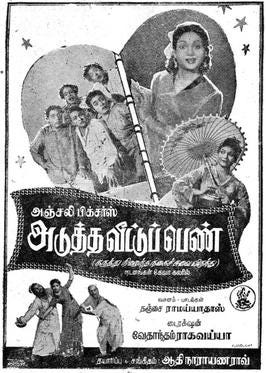
Adutha Veettu Penn (1960) starring T. R. Ramachandran in the lead role provided a hilarious opening for the new decade. It was a laugh riot, a situational comedy soaked in those old tricks boys always do to impress damsels. There is this famous funny song ‘Kangalum kavi paduthey..’ that serves as a template even till this date. AVP was a truly successful comedy film. Sivaji Ganesan’s Bale Pandiya, another landmark comedy, followed it. Still comedy as a genre was not tried often. 1964. Kadhalikka Neramillali. This is a cult comedy that actor Nagesh carried so effortlessly on his shoulders. The scene where Chellapa (Nagesh playing an aspiring film director) narrates a story to his father is rib-tickling even now. Rajnikanth used a similar scene in his comeback film Chandramuki (2005), more or less to the same comic effect. Then came the crop of Nagesh-K Balachander comedy-dramas like Server Sundaram (KB as the writer), Bama Vijayam, Ethir Neechal and so on. Outside these films the concept of ‘comedy track’ was still in vogue taking a helping hand from J.P.Chandrababu, Manorama, Cho and other assorted ‘comedians’. Galatta Kalyanam with its amusing premise was a feather in the cap of the 60s. Again, Sivaji Ganesan proved his mettle with humour.


AVP, the old tricks of boys

1970s was a tumultuous, milestone decade for Tamil films — it marked the generational shift from MGR-Sivaji to Rajni-Kamal; from MSV to Ilayaraja; from Raja-Rani and mythology stuff to serious social and family dramas. Also the legendary directors like KB, Bharathiraja and Mahendran delivered their best in this decade. But what about comedy films? Sorry, the species had just slipped from ‘Endangered’ to ‘Critically endangered’.
Thillu Mullu (a Hindi film remake), the evergreen comedy heralded the 1980s. It presented a very new dimension of Rajnikanth. Supported by Thengai Srinivasan, Sowcar Janaki and an ensemble of cast that includes even Nagesh and Kamal Hassan in minor roles, the film became a benchmark for the genre. Due to the continued efforts of film makers and actors like K.Bhagyaraj (Indru Poi Naalai Vaa, Dhavani Kanavugal), R.Pandirajan (Aan Paavam, Oorai Therunjukitten) and Visu (Dowry Kalyanam, Manal Kayiru), the genre continued to be relevant. In fact the comedy films gained traction in Kollywood. But, while many of the these films were great comedies, the maker comedy film of the decade was still Thillu Mullu released in 1981. The eight years that followed only helped the genre escape the deterioration from ‘Critically endangered’ to ‘Near-extinct’.
Yes, there were great ‘comedy tracks’ during the period, performed exceedingly well by the comic legends like Goundami-Senthil. The 80s too witnessed a revolution in Tamil cinema. Mani Ratnam. But comedy was never his forte. And the auteur even dropped the ‘comedy tracks’ from his films very soon, after attempting it for one last time in Agni Natchathiram(1988).
So this was the B.C. of Tamil comedy films. Before ‘Crazy’.
Now let us move to anno Domino (A.D.), in the year of Tamil comedy God ‘Crazy’ Mohan. It was 17th October, 1990, and Michael Mathana Kama Rajan the greatest Tamil comedy of all times got released. The very previous year, with Apoorva Sagodharargal Crazy had established himself as a real talent on humour and dialog writing. ‘Sir.. neenga engeyo poitenga!’ still lingers in the air. Even Crazy’s Kathanayagan (1988) had memorable funny moments (‘Gaja ka dost’). But with MMKR, Crazy took the onscreen comedy to an altogether higher plane, and set a fresh benchmark. And it was too high for anyone to even attempt beating. Yes, doing all the four titular roles Kamal Hassan played an extraordinary part in creating the onscreen magic of humour.
International Decade of Tamil Comedy Films
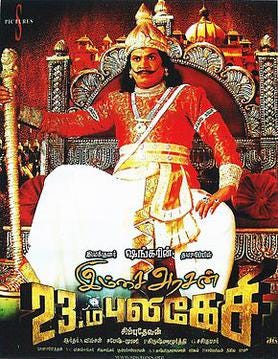
The Crazy-Kamal combo went on to roll out one comedy after another — Magalir Mattum, Sathi Leelavathi, Avvai Shanmugi and Kadhala Kadhala, all in the same decade. Crazy also collaborated (less successfully) with others, and gave memorable comedy film like Chinna Mapillai. The decade also had non-Crazy hits like Nadigan (1990, a 1962 Hindi film remake), Singara Velan (1992) and Ullathai Allithaa (1996) that were pretty high on humour — but nothing could outwit the Crazy waves that consistently lapped the pristine shores of onscren humour. The new millennium too kick started with the Crazy-Kamal combo. Thenali (2000), Panchathantiram (2002),Pammal K Samandham (2002) and Vasool Raja MBBS (2004, a Hindi film remake). Switch on your telly and randomly play any Tamil comedy channel, and don’t be surprised if you end up watching clips from any of these. The other film makers collected the baton and continued to run up the humour track with all sincerity. Soon we had two more cult classics of comedy — Imsai Arasan 23-aam Pulikesi (2006) and Chennai 600028 (2007). Well, the decade of 2000s was easily the most humour-packed years of Tamil cinema. May be the UNO should have it as the International Decade of Tamil Comedy Films.


Imsai Arasan…, A cult comedy

Now, why horror-comedy has taken (is taking) so long to evolve? Simple. Even full length comedy has established itself only in the recent decades. Only in the A.D., comedy has been commanding a place for itself. Before Crazy, there were hardly any takers even for the evergreen material of slapstick or the comedy of errors. But just person (teamed up with a supreme actor) changed the pitch; and also the way games were played.
There have been directors and writers who have given us serial blockbusters. Ellis R. Dungan, B. R. Panthulu, S.P.Muthuraman, P.Vasu, Panchu Arunachalam, Gangai Amaran, Shankar and many more. It is a big deal. But to hand out guarantee consistent hits in just the genre of comedy — it is actually a big deal. When was the last time you just laughed so easily? (Unless the person cracking the joke was your boss.) Before Crazy there were just old sprinklers struggling to keep up the grass green. In A.D. the genre progressed from critically endangered to just vulnerable. A giant leap for any species. The genre blossomed.
Now, in the second decade of the third millennium, in spite of gems like Soodhu Kavvum (2013) we seem to be staring at a scenario of over-population. The makers are worried more about the numbers than about the DNA strength. But that is another story, unfolding every Friday. The latest, weakest member being Dharmaprabhu.
Maestro Ilayaraja — just a single person defined the whole of Tamil cinema music throughout the 1980s. Other than him there was perhaps no other person of any section in the industry, at any point in time, who stood as the only identity for his field of work; the one who had total domination. The sky always had a couple of shining stars and a few dazzling shooting stars. May be a rainbow here or a full moon there. But never a sole star glittering with a beaming smile. But from the year 1990, the comedy sky had one such star. It was ‘Crazy’ Mohan.

The Queen’s Gambit (Review)

(Glad that my review got published in Readers Write  - Thank you so much Baradwaj Rangan! ) Streaming on Netflix and consisting of seven epi...